WEB 2.0
a page by Taneim Miah
About 2,030,000,000 results (0.35 seconds)

Tim O’Reilly: What Is Web 2.0
Sep 30, 2005
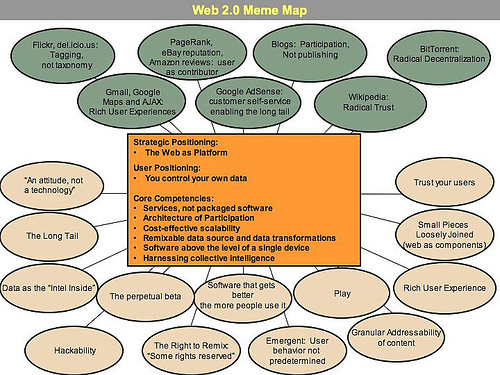
O’Reilly describes Web 2.0 as having a “gravitational core” about which there are many principles that websites adhere to. The main ideas are that there is strategic positioning in the form of the web as a platform, there is user positioning in the form of data control, and there are various core competencies that many websites follow. Some of these core competencies are services on the net, user participation, scalability, cost-effectiveness, emergent data, multiple platforms, and rich user experiences. In web 2.0, websites follow some or all of these principles. These principles revolutionized the web and marks a difference from Web 1.0 to Web 2.0.

Christian Fuchs: Web 2.0 Surveillance and Art
Jul 14, 2012
Fuchs writes about how surveillance of data happens in the age of Web 2.0. Since Web 2.0 started, data and information began to be exchanged rapidly on the internet as people shared their data and information amongst each other online and on various social media websites. According to Fuchs, “one important characteristic of many contemporary web platforms is that they store, process, assess, and sell large amounts of personal information and usage behaviour data.” Therefore, the consideration of surveillance in the digital age is important as it has evolved. Positives of Web 2.0 data sharing are the community aspects and collaboration, long-distance updates, and better data collection. However some negatives of Web 2.0 data sharing are the ways that it enables stalking, selling of user information, and discrimination based on user profiles. A key point Fuchs brings up is how corporate internet is largely dominated and controlled by large companies that expropriate, surveil, and exploit users for monetary gain, and we should consider imagining and creating alternatives.

Oct 23, 2023
Click the link to view a reflection for the two articles that were summarized above.
Citations
Oct 23, 2023
oreilly.com | New York: Routledge | Google Logos | IconDuck